


American Heart Association says Exercise can help keep Medical Costs Down
September 14, 2016
American Heart Association Rapid Access Journal Report
 Dallas, TX – Getting recommended levels of exercise weekly may help keep down annual medical costs both for people with and without cardiovascular disease, according to new research in Journal of the American Heart Association, the Open Access Journal of the American Heart Association/American Stroke Association.
Although it’s well known that regular moderate exercise reduces risk of heart disease, stroke, and chronic conditions such as diabetes and high blood pressure, “our findings also emphasize the favorable impact on how much you pay for healthcare,” said Khurram Nasir, M.D., M.P.H., senior author of the study and director of the Center for Healthcare Advancement & Outcomes and the High Risk Cardiovascular Disease Clinic at Baptist Health South Florida in Coral Gables.

Patients with heart disease who met weekly guidelines for moderate to vigorous exercise saved on average more than $2,500 in annual healthcare costs. (American Heart Association)
American Heart Association says new reversible drug shows early promise in preventing dangerous Clots
December 22, 2015
American Heart Association Rapid Access Journal Report
Dallas, TX – A new drug that protects against dangerous blood clots in patients undergoing procedures such as angioplasty to restore blood flow through the coronary arteries, appears safe, fast, and the effects are uniquely reversible, according to early testing described in the American Heart Association journal: Arteriosclerosis, Thrombosis and Vascular Biology.
Antiplatelet drugs currently available to patients carry an increased risk of bleeding.

A uniquely acting antiplatelet agent, PZ-128, appears to be safe and fast for preventing blood clots and its effects are reversible, reducing risk for excessive bleeding. (American Heart Association)
American Heart Association says Eating more Fruits, Veggies in Youth linked to Healthy Heart decades later
October 28, 2015
American Heart Association Rapid Access Journal Report
Dallas, TX – Eating more fruits and vegetables as a young adult may keep your arteries free of heart disease 20 years later, according to research in the American Heart Association journal Circulation.
Researchers found that eating more fruits and vegetables as young adults was associated with less calcified coronary artery plaque 20 years later. Coronary artery calcium can be measured by a CT scan to detect the presence and amount of atherosclerosis, a disease that hardens arteries and underlies many types of heart disease.

Farmers’ market produce stand showing assorted fruits and vegetables. (American Heart Association)
American Heart Association reports Blacks are at greater risk for Sudden Cardiac Arrest
July 22, 2015
Dallas, TX – Blacks are more likely than whites to experience sudden cardiac arrest and at a much earlier age, according to research published in the American Heart Association’s journal Circulation.
Researchers also found that blacks had higher rates than whites of well-established risk factors for cardiovascular disease, including diabetes (52 percent vs. 33 percent), high blood pressure (77 percent vs. 65 percent), and chronic kidney failure (34 percent vs. 19 percent).
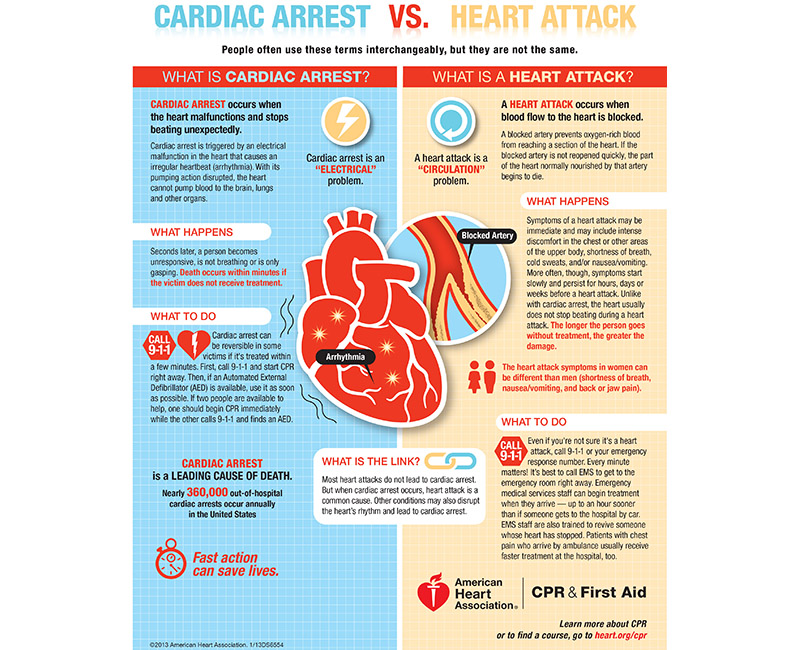
Cardiac Arrest vs. Heart Attack
American Heart Association, two other major organizations issue new recommendations for treating patients with High Blood Pressure and Cardiovascular Disease
April 8, 2015
Dallas, TX – A new scientific statement issued jointly by three medical organizations and published in the American Heart Association’s journal Hypertension, addresses how low to aim when treating patients with high blood pressure who also have vascular diseases.
The document provides an up-to-date summary on treating hypertension in patients who have both high blood pressure and have had a stroke, heart attack or some other forms of heart disease, said Elliott Antman, M.D., President of the American Heart Association and professor of medicine at Harvard Medical School.
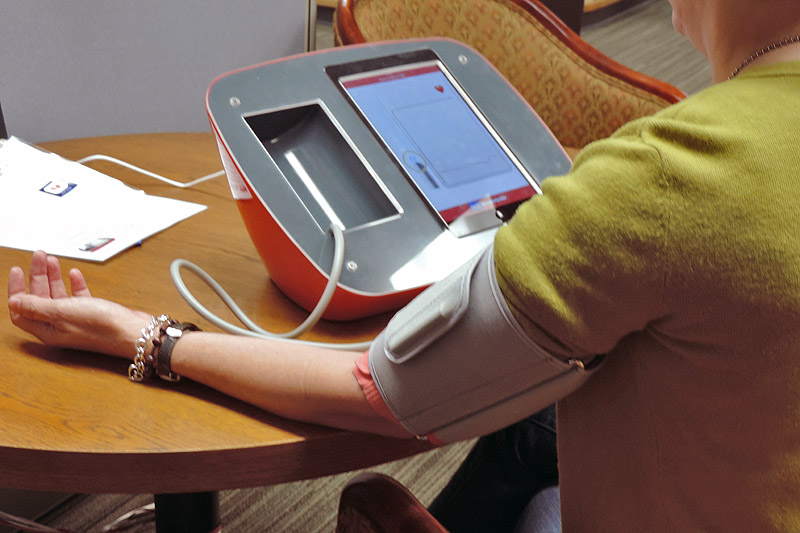
Blood pressure monitoring. (American Heart Association)
American Heart Association says poor response to Cholesterol Drugs may indicate blocked Arteries
March 14, 2015
Dallas, TX – If your “bad” cholesterol level stays the same or increases after you take statin drugs, you may have more blocked arteries than people whose levels drop, according to research in the American Heart Association journal Arteriosclerosis, Thrombosis and Vascular Biology.
Low density lipoprotein (LDL) cholesterol is considered the “bad” cholesterol because it contributes to plaque buildup, thick, hard deposit that can clog arteries and make them less flexible. [Read more]
American Heart Association reports Cocaine users experience Abnormal Blood Flow, risk Heart Disease
November 21, 2014
Chicago, IL – Cocaine users complaining of chest pain may have abnormal blood flow in the heart’s smallest blood vessels that may not be detected in regular testing, putting these patients at risk for heart complications or death, according to research presented at the American Heart Association’s Scientific Sessions 2014.
“Cocaine use is unfortunately very common, and we see many emergency room admissions because patients experience chest pain following cocaine use,” said Varun Kumar, M.D., lead study author and an internist at Mount Sinai Hospital in Chicago. [Read more]
American Heart Association reports Gender-specific research improves accuracy of Heart Disease Diagnosis in Women
June 19, 2014
Dallas, TX – Diagnosing coronary heart disease in women has become more accurate through gender-specific research that clarifies the role of both obstructive and non-obstructive coronary artery disease as contributors to ischemic heart disease in women, according to a new statement published in the American Heart Association journal Circulation.
[youtube]https://www.youtube.com/watch?v=zqS9TRJNR1U[/youtube] [Read more]
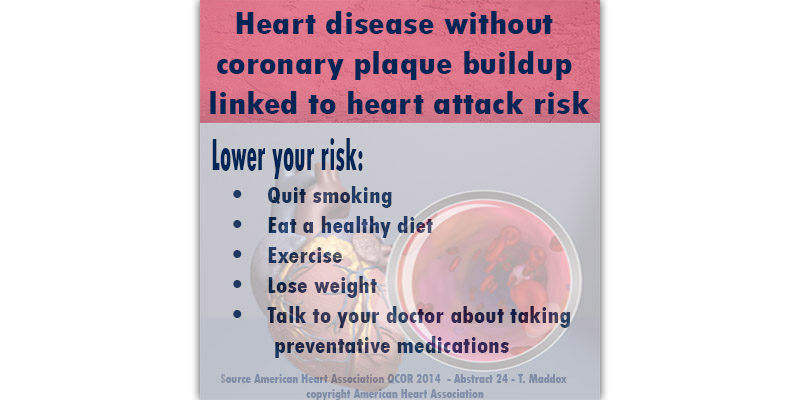
American Heart Association reports Heart Disease without coronary plaque buildup linked to Heart Attack Risk
June 11, 2014
Baltimore, MD – Non-obstructive coronary artery disease was associated with a 28 to 44 percent increased risk of a major adverse cardiac event such as a heart attack or death, in a new study presented at the American Heart Association’s Quality of Care and Outcomes Research 2014 Scientific Sessions.
Non-obstructive CAD damages the walls of the heart’s blood vessels, but doesn’t result in decreased blood flow or symptoms so it’s generally been considered to be a low-risk condition.
American Heart Association says many sudden cardiac arrests preceded by warning signs
December 4, 2013
Dallas, TX – Sudden cardiac arrest isn’t always so sudden, according to research presented at the American Heart Association’s Scientific Sessions 2013.
In a study of middle-age men in Portland, Oregon, more than half had possible warning signs up to a month before their hearts stopped abruptly.
Cardiac arrest occurs when the heart stops due to a failure in its electrical system. Patients can sometimes survive if they receive CPR immediately and a defibrillator is used quickly to shock the heart into a normal rhythm.


