


Tennessee Department of Health says Bats are helpful Insect Eaters and Infrequent Rabies Carriers
August 6, 2014
 Nashville, TN – The recent finding of a bat infected with rabies in Tennessee is a reminder these helpful, flying insect eaters should not be handled by humans.
Although only a few bats are identified with rabies in Tennessee each year, it can only take one contact with an infected bat to transmit the fatal disease. The last human case of rabies in Tennessee occurred over a decade ago when contact with a bat occurred but was not reported.
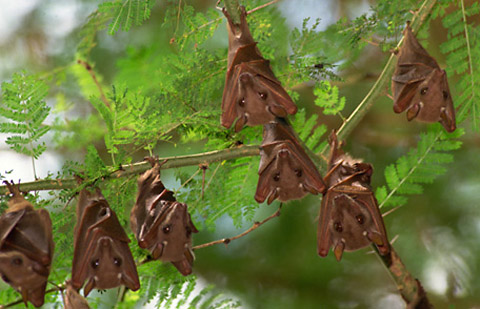
Bats can eat a thousand insects in an hour and are helpful in controlling mosquitoes.
Bats and Campers Benefit from Eagle Scout Project at Land Between the Lakes
September 12, 2012
 Golden Pond, KY – Land Between The Lakes (LBL) National Recreation Area recently benefitted from a local Eagle Scout Project that placed four bat roosting boxes at Wranglers Campground.
After much planning, preparation, and gathering of donations, Liam Parker led fellow Scouts from Murray, KY’s Boy Scout Troop 45 in installing the boxes on August 18th.

Liam Parker with Boy Scout Troop 45, Murray, KY, Eagle Scout Project at Wranglers Campground in Land Between The Lakes National Recreation Area. (Photo by Aviva Yasgur)
TWRA reports State of Tennessee extends Public Caves Closure into Fourth Year to Protect Bats in Southeast
June 14, 2012
 Nashville, TN – Caves located on state lands in Tennessee will remain closed in an effort to slow the spread of White Nose Syndrome (WNS) among the state’s bat population.
During the upcoming year, state and federal agencies and non-governmental organizations will consult with recreational caving organizations to determine how to best manage the spread of this disease while maintaining high quality recreation. Biologists will also continue to work with researchers to better understand WNS and determine the best ways to mitigate the effects of WNS on Tennessee’s bats. [Read more]
State of Tennessee extends Public Caves Closure into third year to protect Bats in Southeast
June 3, 2011
Nashville, TN – Caves located on state lands in Tennessee will remain closed in an effort to slow the spread of White Nose Syndrome (WNS) among the state’s bat population. During the upcoming year, state and Federal agencies and non-governmental organizations will consult with recreational caving organizations to determine how to best manage the spread of this disease while maintaining high quality recreation.
State land holding agencies including Tennessee Wildlife Resources Agency, the Tennessee Department of Environment and Conservation, and the Tennessee Department of Agriculture initially agreed to close all caves on public property beginning July 1st, 2009. The Nature Conservancy has also agreed to follow the state’s lead to extend the closure on all caves located on Conservancy property. [Read more]


