American Heart Association reports Gene Editing Technology may improve accuracy of predicting individuals’ Heart Disease Risk
July 12, 2018
American Heart Association Circulation Journal Report
 Dallas, TX – Scientists may now be able to predict whether carrying a specific genetic variant increases a person’s risk for disease using gene editing and stem cell technologies, according to new research in the American Heart Association’s journal Circulation.
For the first time, the study demonstrates the unique potential of combining stem cell-based disease modeling (Induced pluripotent stem cells) and CRISPR/Cas9-mediated genome editing technology as a personalized risk-assessment platform for determining the disease-causing ability of a yet undescribed genetic variant, known as a “variant of uncertain significance” or VUS.

Gene-editing technology may help scientists discern whether genetic variations with undetermined effects are harmless or dangerous. (American Heart Association)
American Heart Association reports Performance, Quality Measures Updated for Patients with Atrial Fibrillation
June 29, 2016
Washington, D.C. – The American College of Cardiology and the American Heart Association today released updated clinical performance and quality measures for treating adult patients with atrial fibrillation or atrial flutter. This document updates the previous measure set that was released in 2008 and for which implementation notes were issued in 2011.
“Atrial fibrillation is the most common cardiac arrhythmia in the United States,” said Paul A. Heidenreich, M.D., M.S., FACC, professor and vice-chair for clinical, quality and analytics in the department of medicine at the Stanford University School of Medicine and the chair of the writing committee. “This condition impacts between 2.7 million and 6.1 million American adults, and this number is expected to double by 2050. Updating the measure set was a priority for the ACC and AHA.”

Heart Illustration. (American Heart Association)
American Heart Association says costs to treat Heart Failure expected to more than double by 2030
May 5, 2013
Strategies to prevent and treat heart failure are needed to curb the rise in the incidence of heart failure
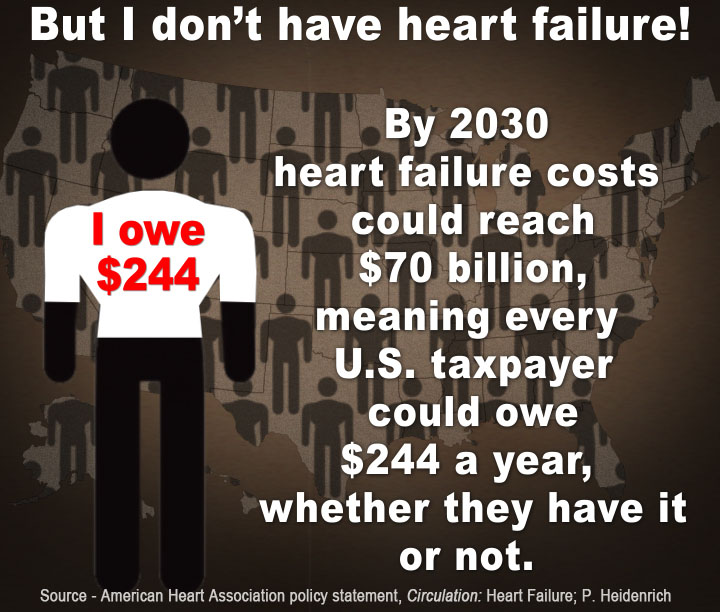
Dallas, TX – By 2030, you — and every U.S. taxpayer — could be paying $244 a year to care for heart failure patients, according to an American Heart Association policy statement.
The statement, published online in the American Heart Association journal Circulation: Heart Failure, predicts the number of people with heart failure could climb 46 percent from 5 million in 2012 to 8 million in 2030. Direct and indirect costs to treat heart failure could more than double from $31 billion in 2012 to $70 billion in 2030.