


Many Stroke Survivors don’t receive timely rehab
January 29, 2018
 Los Angeles, CA – Whether they are referred to home-based or outpatient rehabilitation after hospital discharge, many stroke patients don’t receive rehabilitation services, according to preliminary research presented at the American Stroke Association’s International Stroke Conference 2018, a world premier meeting dedicated to the science and treatment of cerebrovascular disease for researchers and clinicians.

Timely rehabilitation after stroke is essential to optimize recovery. (American Heart Association)
Stress management may enhance cardiac rehab, improve recovery
March 23, 2016
American Heart Association Rapid Access Journal Report
Dallas, TX – Heart patients may benefit from cardiac rehabilitation (rehab) programs even more when stress management is added, according to new research in the American Heart Association’s journal Circulation.
“Cardiac rehabilitation programs do not routinely offer stress management, but this may change should demand increase. And because patients may be reluctant to ask for the programs themselves, the onus is on the physicians to recognize that stress management is important for the optimal medical management of patients,” said James A. Blumenthal, Ph.D., professor of Psychiatry and Behavioral Sciences at Duke University School of Medicine in Durham, North Carolina.

Adding stress management into cardiac rehabilitation programs should be encouraged, researchers say. (American Heart Association)
American Heart Association reports Social and Practical Barriers keep Heart Failure Patients from benefits of Exercise Therapy
November 25, 2015
American Heart Association Rapid Access Journal Report
Dallas, TX – Although supervised aerobic physical activity is a proven therapy for heart failure patients, lack of social support and practical barriers such as lack of transportation, keep many patients from benefitting from cardiac rehab programs, according to new research in Circulation: Heart Failure, an American Heart Association journal.

Yoga
Go Red For Women Makes Connections Through Heart Match
May 16, 2012
American Heart Association’s first women’s online patient support program provides support for women fighting their No. 1 killer; Smyrna woman part of national launch
Nashville, TN – A matchmaking site, for ladies only – that could help save their lives?
Go Red Heart Match is a matchmaker with a mission.
The brand-new site is the American Heart Association’s first women’s online patient support program, where women dealing with cardiovascular conditions receive added support by connecting them online with others around the country with similar heart stories – whether that be a heart disease diagnosis, caring for a loved one with heart disease or working to prevent heart disease.
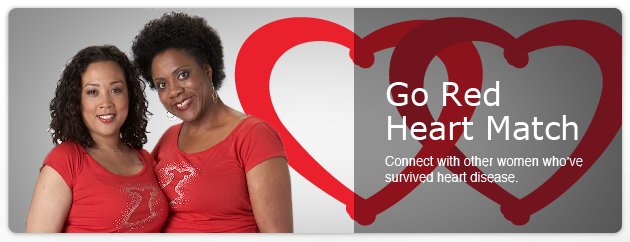
Rolanda Perkins of Smyrna, Tennessee, right, is featured on the American Heart Association’s Go Red Heart Match website.
American Heart Association reports Exercise slows muscle wasting from Age and Heart Failure
May 15, 2012
Supports Use of Cardiac Rehab at any Age
Dallas, TX – Exercise can counteract muscle breakdown, increase strength and reduce inflammation caused by aging and heart failure , according to new research in Circulation, an American Heart Association journal.
The benefits for heart failure patients are similar to those for anyone who exercises: there’s less muscle-wasting, and their bodies become conditioned to handle more exercise.
Age of the patients didn’t matter, either, researchers found. [Read more]
Robot therapy can improve arm, shoulder mobility after stroke
February 16, 2011
Los Angeles, CA – Therapy in which robots manipulate paralyzed arms, combined with standard rehabilitation, can improve arm and shoulder mobility in patients after stroke, according to research presented at the American Stroke Association’s International Stroke Conference 2011.
Patients on robotic therapy showed marked improvement in two measures of upper extremity function: the Fugl-Meyer flexor synergy score, a 0 to 12 scale with higher numbers reflecting recovery of voluntary arm movement; and the Fugl-Meyer shoulder/elbow/forearm score, a 0 to 36 scale with higher numbers reflecting recovery of motor function in the shoulder, elbow and forearm.
[youtube]http://www.youtube.com/watch?v=7tDGTQ47w_4[/youtube]


