


American Heart Association says Smoke-free policies associated with Lower Blood Pressure
December 3, 2018
Journal of the American Heart Association Report
 Dallas, TX – Smoke-free policies have been associated with lower systolic (top number) blood pressure readings among non-smokers, according to new research in Journal of the American Heart Association, the Open Access Journal of the American Heart Association/American Stroke Association.
While smoke-free policies – laws that prohibit smoking in public places like bars and restaurants – have been associated with reduced rates of hospitalization for heart disease, previous studies have not examined changes in blood pressure.

Non-smokers who had access to smoke-free restaurants, bars and workplaces had lower systolic blood pressure readings than those who lived in areas without smoke-free laws. (American Heart Association)
American Heart Association says Golden Years are longer and healthier for those with Good Heart Health in Middle Age
May 11, 2017
American Heart Association Rapid Access Journal Report
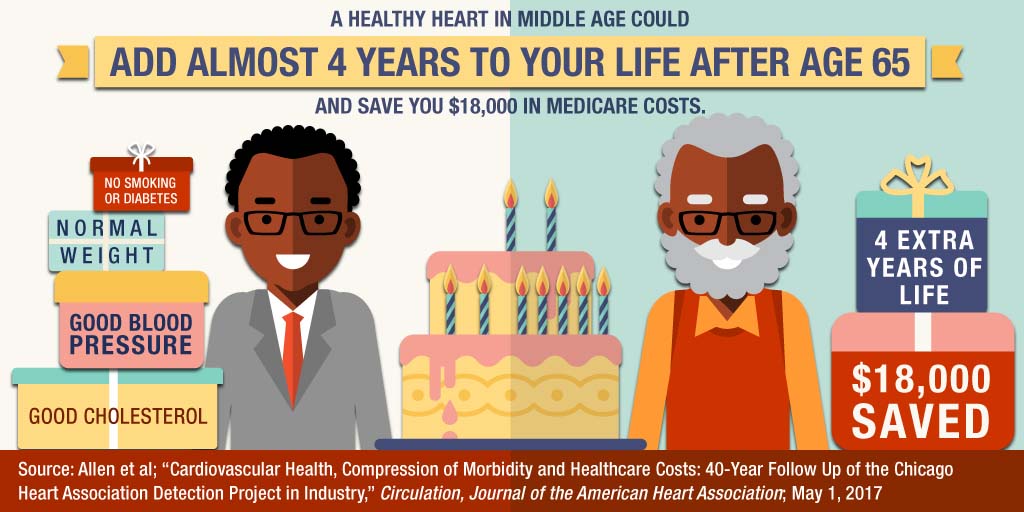
Dallas, TX – People with no major heart disease risk factors in middle age live longer and stay healthy far longer than others, according to a 40-year study reported in the American Heart Association’s journal Circulation.
“Good cardiovascular health in middle age delays the onset of many types of disease so that people live longer and spend a much smaller proportion of their lives with chronic illness,” said Norrina Allen, Ph.D., M.P.H., assistant professor of preventive medicine at Northwestern University Feinberg School of Medicine in Chicago.
American Heart Association reports Overweight and obese people are burdened by cardiovascular disease at younger ages
March 12, 2017
American Heart Association Meeting Report
Portland, OR – People who are overweight or obese may live as long as or less than those of healthy weight, but they experience cardiovascular disease at an earlier age and live longer burdened by the disease, according to research presented at the American Heart Association’s Epidemiology and Prevention / Lifestyle and Cardiometabolic Health 2017 Scientific Sessions.

Overweight and obese people have a higher risk of developing cardiovascular disease in their lifetime. (American Heart Association)
Short episodes of Abnormal Heart Rhythm may not increase Risk of Stroke
October 18, 2016
American Heart Association Rapid Access Journal Report
Dallas, TX – People with pacemakers or defibrillators who experience only short episodes of an abnormal heart rhythm known as atrial fibrillation have a very low risk of stroke, suggesting that anticoagulants in this group of patients were not likely to reduce the risk for stroke, according to new research in the American Heart Association’s journal Circulation.
Atrial fibrillation is the most common abnormal heart rhythm, affecting approximately 2.7 million Americans.
People with pacemakers or defibrillators who experience short episodes an abnormal heart rhythm called atrial fibrillation have no higher risk for stroke or other medical complications than people without documented atrial fibrillation. (American Heart Association)
American Heart Association report shows nearly half of Hispanics unaware they have High Cholesterol; less than a third treated
July 5, 2015
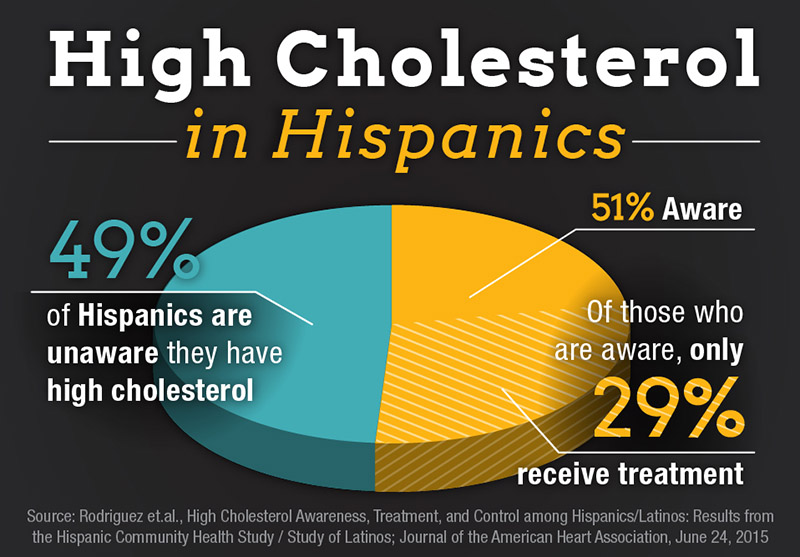
Dallas, TX – Nearly half of Hispanic adults were unaware they have high cholesterol, and less than a third receive any kind of cholesterol treatment, in a new study in Journal of the American Heart Association.
Hispanics are one of the fastest growing ethnic groups in America, with 52 million among the U.S. population, yet their awareness and management of high cholesterol lags behind other ethnic groups.
American Heart Association reports Home-based Walking Program eases clogged Leg Arteries
May 23, 2014
Dallas, TX – A home-based exercise program helped people with clogged leg arteries walk farther and faster, according to new research in the Journal of the American Heart Association. The program was beneficial even 12 months after participants started the program.
Previously, studies have shown that supervised exercise can improve walking and lessen the symptoms of peripheral artery disease (PAD), but this is the first to document the long-term benefits of a home-based walking program.

Physicians should recommend walking even if their patients don’t have access to a supervised exercise program. (American Heart Association)
American Heart Association says Healthcare providers should aggressively treat unhealthy lifestyles
October 17, 2013
Dallas, TX – Healthcare providers should treat unhealthy behaviors as aggressively as they treat high blood pressure, cholesterol and other heart disease risk factors, according to an American Heart Association science advisory published in Circulation.
“We’re talking about a paradigm shift from only treating biomarkers — physical indicators of a person’s risk for heart disease — to helping people change unhealthy behaviors, such as smoking, unhealthy body weight, poor diet quality and lack of physical activity,” said Bonnie Spring, Ph.D., lead author of the statement and a professor of preventive medicine and psychiatry and behavioral sciences at Northwestern University in Chicago. [Read more]
American Heart Association reports People in neighborhoods with healthy features have better heart health
March 17, 2012
Residents of neighborhoods with more healthy food stores, parks, trails and enjoyable walking environments were more likely to be in ideal cardiovascular health.
San Diego, CA – If you live in neighborhoods with access to grocery stores, healthy food, parks and a pleasant walking environment, you’re more likely to be in ideal cardiovascular health.
That’s the finding of research reported at the American Heart Association’s Epidemiology and Prevention/Nutrition, Physical Activity and Metabolism 2012 Scientific Sessions. [Read more]


