


Gas Prices continue to slowly fall
December 14, 2019
 Tampa, FL – At $2.57, AAA says the national gas price average is a penny cheaper on the week. The majority of states saw minimal movement at the pump in the last week, several saw decreases of up to four cents while fewer than a dozen states saw gas prices increase.
“Since the end of October, gasoline demand has mostly decreased as gasoline stocks have mostly increased, paving the way for cheaper gas prices,” said Jeanette Casselano, AAA spokesperson.

Gas prices look to continue their steady decrease. (AAA)
Crude Oil Prices Spike Following Attacks on Saudi Arabian Oil Facilities
September 16, 2019
Tampa, FL – On the week, the national gas price average held steady at $2.56, but motorists can expect some volatility at the pump in the coming days and weeks.
Over the weekend, Saudi Arabia experienced drone attacks on two major oil facilities – including the world’s largest, Abqaiq. The attacks have taken 5.7 million (crude) barrels per day off the market, accounting for about 6% of the global supply.

Americans Can Expect Pump Price Jumps Coming to Stations as Soon as this Week. (AAA)
AAA says Most Consumers Continue to See Decreases at Gas Pump
September 4, 2019
Tampa, FL – On the week, AAA says gas prices are as much as nine cents cheaper in every state except California, (+5 cents), Florida (+4 cents), Ohio (+2 cents) and South Carolina (+1 cent).
Hurricane Dorian has been the driver for the increases in Florida and, most likely, South Carolina.

Hurricane Dorian Puts Pressure on Florida Gas Prices. (AAA)
Demand at All-Time High, Slowing Pump Price Decreases
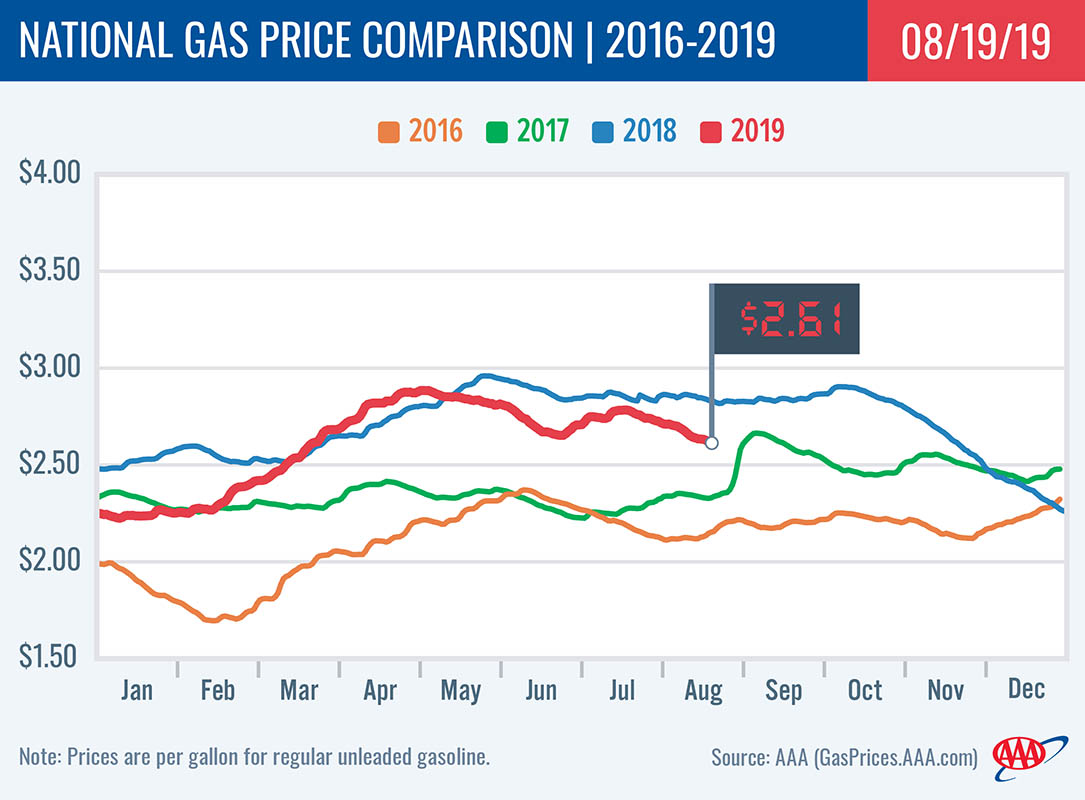
August 24, 2019
Tampa, FL – AAA says summer may be ending, but gasoline demand is soaring to new heights. In its latest reading, the Energy Information Administration (EIA) recorded demand at 9.93 million b/d, the highest since the agency began recording data in 1991.
As demand jumped, gasoline stocks fell by 1.4 million bbl and pump prices slowed their decline on the week.
National Gas Price Average Falls For First Time in Three Months
June 6, 2018
AAA
 Tampa, FL – Dropping by two-cents on the week, the national gas price average is $2.95 reports AAA. This is the first time there has been a decrease in the national average since mid-March.
The drop, albeit it small, follows the latest Energy Information Administration (EIA) report showing consistently strong demand although it is running slightly below (100,000 b/d less) the same week last year.


