


Call on President Donald Trump’s Action to Protect Seniors with Diabetes
May 26, 2020
 Washington, D.C. – MR. CANTRELL: Thank you, Operator. Good morning everyone, and thank you for joining today’s briefing by senior administration officials on the President’s latest action to reduce healthcare costs.
Today’s briefing will be conducted by Administrator for the Centers for Medicare and Medicaid Services Seema Verma and Assistant to the President and Senior Counselor Kellyanne Conway.

Meal planning, timing, may impact heart health according to American Heart Association
January 31, 2017
American Heart Association Scientific Statement
 Dallas, TX – Planning when to eat meals and snacks and not skipping breakfast, are patterns associated with healthier diets, which could reduce cardiovascular disease risk, according to a new scientific statement published in the American Heart Association journal Circulation.
The statement provides a snapshot of the current scientific evidence suggesting when and how often people eat may impact risk factors for heart attack, stroke, or other cardiac or blood vessel diseases.

Planning and timing meals and snacks, such as not skipping breakfast and allocating more calories earlier in the day, might help reduce cardiovascular disease risk. (American Heart Association)
American Heart Association says Kids need to be Protected from toxic Secondhand Smoke
September 15, 2016
American Heart Association Scientific Statement
Dallas, TX – Parents and policy advocates should take a “zero tolerance” approach to exposing children to secondhand cigarette smoke, which can be responsible for lifelong cardiovascular consequences in addition to respiratory and other health issues, according to a new scientific statement published in the American Heart Association journal Circulation.

American Heart Association says Kids need to be Protected from toxic Secondhand Smoke. (American Heart Association)
Children should eat less than 25 grams of added sugars daily according to American Heart Association
August 27, 2016
American Heart Association Scientific Statement
 Dallas, TX – Children ages 2 to 18 should eat or drink less than six teaspoons of added sugars daily, according to the scientific statement recommending a specific limit on added sugars for children, published in the American Heart Association journal Circulation.
Six teaspoons of added sugars is equivalent to about 100 calories or 25 grams.
“Our target recommendation is the same for all children between the ages of 2 and 18 to keep it simple for parents and public health advocates,” said Miriam Vos, M.D., Ms.P.H, lead author, nutrition scientist and associate professor of pediatrics at Emory University School of Medicine in Atlanta, Georgia.
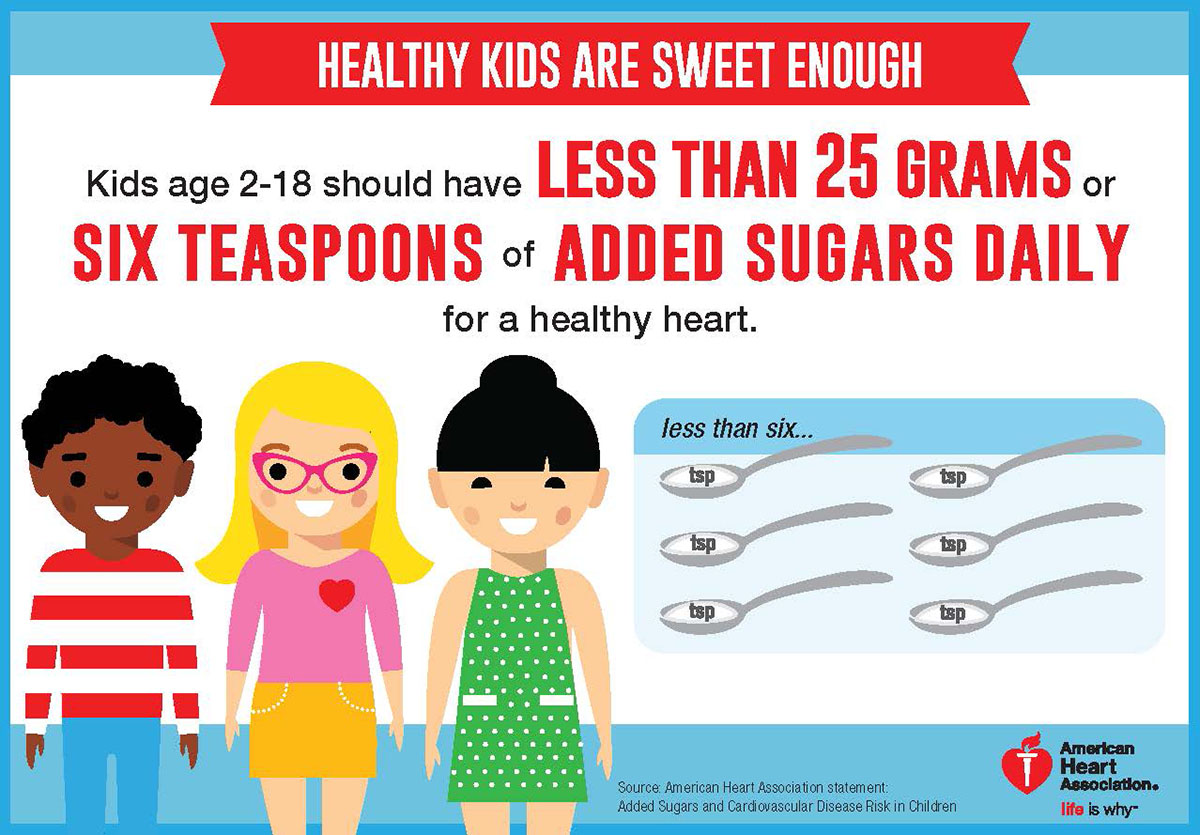
Healthy kids are sweet enough. Kids age 2-18 should have less than 25 grams or six teaspoons of added sugar daily for a healthy heart. (American Heart Association)
Tennessee Department of Health says Everyone has a role in Diabetes Prevention, Education and Support
November 29, 2015
 Nashville, TN – More than 29 million Americans, including more than 600,000 Tennessee adults, have diabetes. It is estimated one in every four people with diabetes does not even know he or she has the disease.
The Tennessee Department of Health is reminding Tennesseans during National Diabetes Month that diabetes is a disease that can be treated, and with some lifestyle changes some individuals can even prevent or reverse the course of the disease.

American Heart Association reports Moderate Coffee Drinking may be linked to reduced risk of Death
November 22, 2015
American Heart Association Rapid Access
Dallas, TX – Drinking a second or third cup of coffee may do more than get you through a long day — it may also reduce your risk of death from heart disease and other illnesses.
In a study reported in the American Heart Association journal Circulation, people who regularly drank moderate amounts of coffee daily —less than 5 cups per day — experienced a lower risk of deaths from cardiovascular disease, neurological diseases, Type 2 diabetes and suicide.

Coffee being poured. (American Heart Association)
Tennessee Department of Health Provides Information About the Value of Sleep
July 31, 2014
Now I Lay Me Down To …
 Nashville, TN – Sleep is not a luxury; it is a basic health need long known to affect a person’s ability to think and function.
Increasingly scientists and researchers are learning more about other values of sleep that may impact health and help improve and extend lives. [Read more]
Tennessee Department of Health says “Tennessee Needs To Get Moving”
December 17, 2012
America’s Health Rankings Show Improvements In Tennessee
 Nashville, TN – Tennessee has shown marked improvements in 12 measures of overall health in the last five years, according to a newly released report, but with a ranking of 48th in sedentary lifestyle among all states, most Tennesseans need to “get moving” to make more progress.
The United Health Foundation’s 23rd annual America’s Health Rankings report lists Tennessee at 39th overall this year. The state moved up two spots from a recalculated 41st in 2011 in the foundation’s evaluation and measures of how states perform in different categories. [Read more]
American Heart Association says Consuming flavanol-rich cocoa may enhance brain function
August 24, 2012
Consuming cocoa flavanols as a part of a calorie-controlled and nutritionally-balanced diet could improve brain function.
Dallas, TX – Eating cocoa flavanols daily may improve mild cognitive impairment, according to new research in the American Heart Association’s journal Hypertension.
Each year, more than six percent of people aged 70 years or older develop mild cognitive impairment, a condition involving memory loss that can progress to dementia and Alzheimer’s disease. [Read more]
Jenny Craig rated Best Diet; Weight Watchers scores a distant Third
May 11, 2011
 Yonkers, NY – Jenny Craig, the diet program that combines counseling with a portion-controlled regimen of pre-made foods supplemented by home cooked sides, has been designated a Ratings winner by Consumer Reports Health. With an overall score of 85, Jenny Craig easily surpassed the popular Weight Watchers (57) program by nearly 30 points.
The diet Ratings are based on adherence to nutritional guidelines set forth by the 2010 U.S. Dietary Guidelines for Americans, and weight loss and drop-out rates, both short-term and long-term, derived from published clinical trials. And that’s where Jenny Craig excelled. In a 332-person, two-year study of the program published in the Journal of the American Medical Association, 92 percent of participants stuck with Jenny Craig for two years, a remarkable level of adherence. As a result, those participants shaved off an average of about 8 percent of their weight. [Read more]


