


American Heart Association says E-cigarettes take serious toll on Heart Health, Not Safer than Traditional Cigarettes
November 13, 2019
 Dallas, TX – According to new research that will be presented at the American Heart Association’s Scientific Sessions 2019, November 16th-18th in Philadelphia, E-cigarette use takes a serious toll on heart health — a big concern given the high prevalence of e-cigarettes and perception of e-cigarettes as a healthier alternative to traditional cigarettes.

E-cigarettes negatively impact the heart’s blood flow — possibly more chronically so than traditional cigarettes. (American Heart Association)
American Heart Association says Maintaining Weight Loss beneficial for people with Type 2 Diabetes
October 22, 2019
Dallas, TX – According to new research published in the Journal of the American Heart Association, the open access journal of the American Heart Association people with Type 2 diabetes who regained weight forfeited the initial benefits of reduced risk of heart disease or stroke compared to those who maintained their weight loss.
Regaining weight previously lost is common and can deteriorate the initial benefits of lowered heart disease or stroke risks.

Keeping off at least 75% of lost weight sustained or improved the initial benefits. (American Heart Association)
American Heart Association says Seven Heart-Healthy Habits could save billions in Medicare costs
February 2, 2017
American Heart Association Rapid Access Journal Report
 Dallas, TX – More than $41 billion a year in Medicare costs could be saved if all beneficiaries achieved ideal levels for five to seven heart-healthy habits to reduce cardiovascular risk, according to new research in Journal of the American Heart Association, the Open Access Journal of the American Heart Association/American Stroke Association.

At least $41 billion annually in Medicare costs could be saved if beneficiaries adopted five to seven of the American Heart Association’s Life’s Simple 7 healthy habits to reduce cardiovascular disease.
American Heart Association says Metabolic Abnormalities may increase Cardiovascular risk more in Black Women than in White Women
May 25, 2015
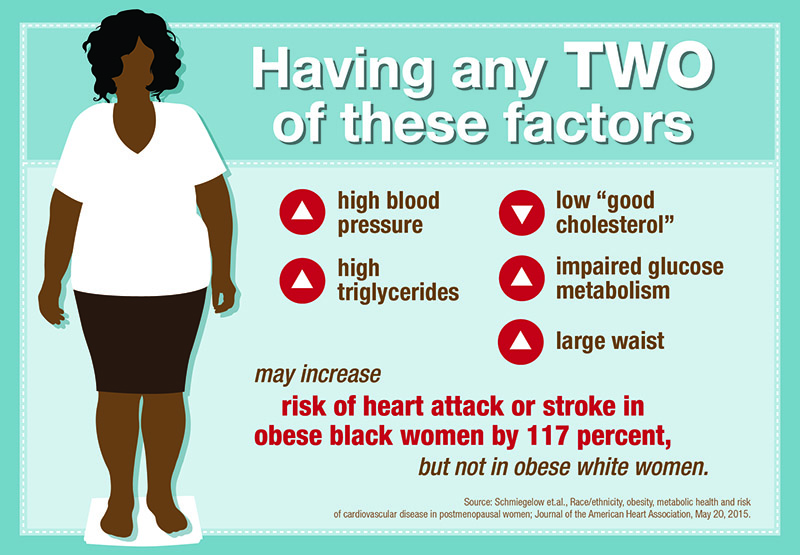
Large waistline, cholesterol disorders and other metabolic abnormalities may increase the relative risk of cardiovascular disease more among black women than among white women.
Dallas, TX – Large waistline, cholesterol disorders and other metabolic abnormalities may increase the risk of cardiovascular disease more among black women than among white women, according to new research in Journal of the American Heart Association.
Previous studies have focused primarily on white participants and found that obesity without a clustering of at least three metabolic disorders (metabolic syndrome) was not associated with increased cardiovascular disease risk.
American Heart Association reports Inflammation may be key to Diabetes/Heart Disease link
September 23, 2014
San Francisco, CA – Inflammation may be the reason high blood sugar levels damage blood vessels, raising the possibility that anti-inflammatory medications might someday be used to lower the risk of blood vessel disease in people with diabetes, according to a study presented at the American Heart Association’s High Blood Pressure Research Scientific Sessions 2014.
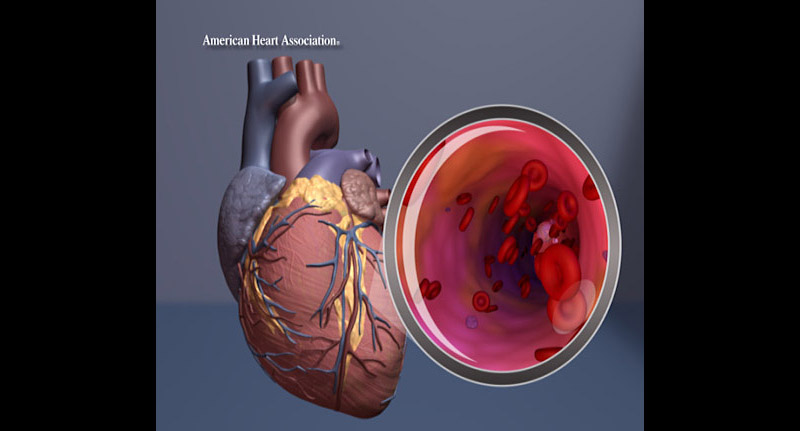
Heart illustration with artery close up. (American Heart Association)
American Heart Association reports Heart-Healthy Diet helps Men lower Bad Cholesterol, regardless of Weight Loss
May 12, 2013
Nashville, TN – A heart-healthy diet helped men at high risk for heart disease reduce their bad cholesterol, regardless of whether they lost weight, in a study presented at the American Heart Association’s Arteriosclerosis, Thrombosis and Vascular Biology 2013 Scientific Sessions.
The 19 24- to 62-year-old men in the study had metabolic syndrome, which refers to three or more significant risk factors for heart disease and stroke. The risk factors included in this study were high waist circumference, high blood pressure, high levels of triglycerides and fasting glucose and low levels of high density lipoprotein or HDL “good” cholesterol. [Read more]
American Heart Month reminds us what we can do to beat the No. 1 killer
February 1, 2012
Nashville, TN – Today is the start of American Heart Month and it’s a good time to look at the statistics – and how we can improve them.
Cardiovascular disease is still the No. 1 killer of men and women, killing about 800,000 Americans each year, and nearly 20,000 right here in Tennessee. That’s more than the next four causes of death combined, including all forms of cancer. [Read more]
Start Eating Healthy Day on November 2nd reminds you to be smart before you bite
November 2, 2011
Nashville, TN – Coming at just the right time after the Halloween supersized sugar rush and before the holiday (overeating) season kicks in, Start Eating Healthy Day on Wednesday, November 2nd encourages everyone to be smart before you bite and make those healthy eating choices that will help your health. [Read more]
Sugar-sweetened drinks associated with higher blood pressure
March 4, 2011
Dallas, TX – Soda and other sugar-sweetened beverages such as fruit drinks are associated with higher blood pressure levels in adults, researchers report in Hypertension: Journal of the American Heart Association.
In the International Study of Macro/Micronutrients and Blood Pressure (INTERMAP), for every extra sugar-sweetened beverage drunk per day participants on average had significantly higher systolic blood pressure by 1.6 millimeters of mercury (mm Hg) and diastolic blood pressure higher by 0.8 mm Hg. This remained statistically significant even after adjusting for differences in body mass, researchers said.

Sugar-sweetened drinks associated with higher blood pressure
Treating Diabetes With Less Need for Insulin
February 14, 2011
New approach lowers blood sugar in both type 1 and type 2 diabetes
 Boston, MA – Diabetes can result from either a deficiency of insulin (type 1 or insulin-dependent diabetes) or decreased sensitivity to insulin (type 2 diabetes). Researchers at Children’s Hospital Boston have discovered a mechanism for normalizing blood sugar that doesn’t involve insulin and could offer a new therapeutic approach to both kinds of diabetes.
Reporting in Nature Medicine online on February 13th, Umut Ozcan, MD, and colleagues in Children’s Division of Endocrinology show that a regulatory protein called XBP-1s, when activated artificially in the liver, can normalize high blood sugar in both lean, insulin-deficient type 1 diabetic mice and obese, insulin-resistant type 2 diabetic mice. This suggests that approaches aimed at increasing XBP-1s activity may benefit patients with either type of diabetes. [Read more]


