


One in six people worldwide will have a stroke in their lifetime; World Stroke Day is October 29th
October 24, 2013
According to a new survey, people more likely to witness a stroke might not know how to identify one; free app helps people Spot a Stroke F.A.S.T.
 Nashville, TN – Crystal Wall was having a typical chat on the phone with her sister Chassity Anderson — until her sister’s phone abruptly crashed to the floor and her words suddenly became slurred.
Anderson, 37, was having another stroke.
“Because my sister had suffered from stroke before, I recognized the warning signs and knew to call 9-1-1,” Wall said. “I know stroke is something that can happen to anyone at any time and if it does, you have to act quickly. The longer you wait, the worse it can be.” [Read more]
American Heart Association says that in mild strokes, ultra-early treatment may eliminate risk of disability
August 26, 2013
Dallas, TX – In the case of mild or moderate strokes, getting treatment ultra-fast – within 90 minutes of experiencing symptoms – greatly reduces the risk of suffering disability, according to a new study reported in the American Heart Association’s journal Stroke.
The American Heart Association/American Stroke Association recommends getting to a hospital within three hours of the onset of stroke symptoms. According to guidelines, clot-busting drugs may be given to treat stroke up to 4.5 hours after the onset of symptoms.
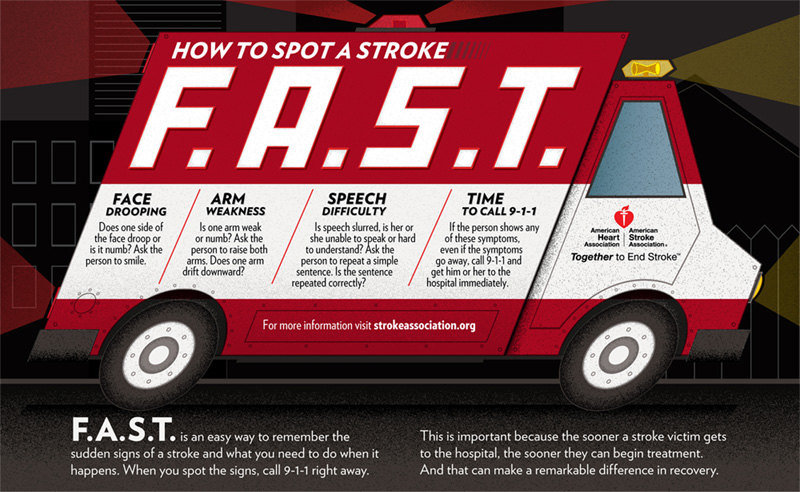
Think FAST
American Heart Association reports one in three Stroke Emergencies don’t use EMS
May 9, 2013
Those living in Southern states were less likely to call 9-1-1 than their Northern counterparts.
Dallas, TX – More than a third of stroke patients don’t get to the hospital by ambulance, even though that’s the fastest way to get there and the quickest way to get vital treatment, according to new research in Circulation: Cardiovascular Quality and Outcomes, an American Heart Association journal.
Researchers studied records on more than 204,000 stroke patients arriving at emergency rooms at 1,563 hospitals participating in the American Heart Association/American Stroke Association’s Get With The Guidelines®-Stroke quality improvement program in 2003-10.
Think FAST


