


American Heart Association says High Blood Pressure and Brain Health are Linked
October 12, 2016
American Heart Association Scientific Statement
 Dallas, TX – High blood pressure, especially in middle age, is associated with an increased risk of cognitive impairment later in life, according to a new statement from the American Heart Association.
The statement, which was published in the American Heart Association journal Hypertension, reviewed multiple studies and provides an overview of what is currently known about how high blood pressure influences brain diseases such as stroke, vascular cognitive impairment and Alzheimer’s disease.

Doctor reviewing brain image up close. (American Heart Association)
American Heart Association says seeing doctor twice a year helps keep Blood Pressure under control
October 27, 2014
Dallas, TX – People who visited their doctor at least twice a year were 3.2 times more likely to keep their blood pressure under control than those who saw their doctor once a year or less, according to new research in the American Heart Association’s journal Circulation.
Having healthcare insurance and getting treated for high cholesterol also increased the likelihood of keeping blood pressure under control.
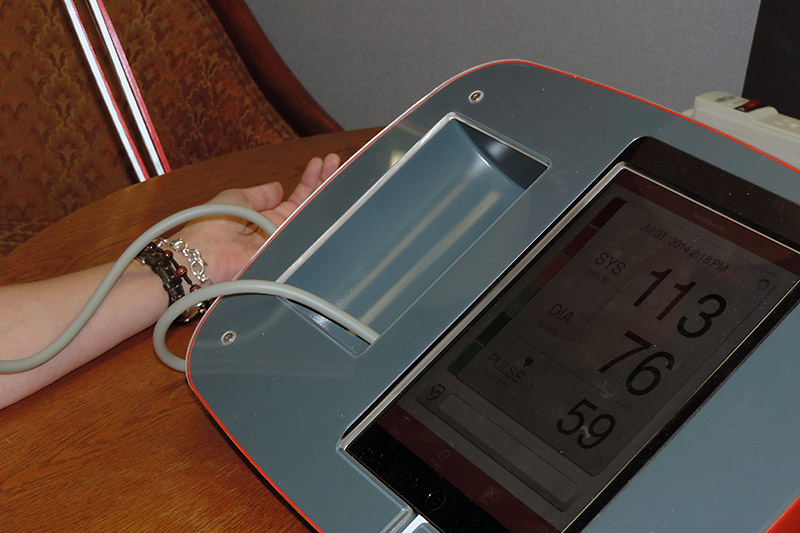
Blood pressure kiosk at work. (American Heart Association)
American Heart Association says Anxiety, Depression in Heart Disease Patients linked to increased risk of Dying
June 5, 2013
The findings suggest more frequent monitoring is needed for heart patients with anxiety and depression.
Dallas, TX – Heart disease patients who have anxiety have twice the risk of dying from any cause compared to those without anxiety, according to new research in the Journal of the American Heart Association.
Patients with both anxiety and depression have triple the risk of dying, researchers said.
“Many studies have linked depression to an increased risk of death in heart disease patients,” said Lana Watkins, Ph.D., lead author of the study and an associate professor in Psychiatry and Behavioral Sciences at Duke University Medical Center in Durham, NC. “However, anxiety hasn’t received as much attention.” [Read more]
American Heart Association reports Healthy diet may help prevent recurrent Heart Attacks, Strokes
December 5, 2012
The benefits of eating right were in addition to those from taking preventive drugs, even in countries with varying economic levels.
Dallas, TX – If you have cardiovascular disease , a heart-healthy diet may help protect you from recurrent heart attacks and strokes, according to new research in the American Heart Association journal Circulation.
“At times, patients don’t think they need to follow a healthy diet since their medications have already lowered their blood pressure and cholesterol — that is wrong,” said Mahshid Dehghan, Ph.D., study author and a nutritionist at the Population Health Research Institute, McMaster University in Hamilton, Ontario, Canada. “Dietary modification has benefits in addition to those seen with aspirin, angiotensin modulators, lipid-lowering agents and beta blockers.”

A diet rich in vegetables and fruits with a higher ratio of fish External link to meats appeared to be more beneficial for preventing heart disease. (Photo by American Heart Association)
Low calorie Cranberry Juice lowers Blood Pressure in healthy adults
September 25, 2012
American Heart Association News Tip – Abstract 299
Washington, D.C. – Regularly drinking low-calorie cranberry juice may help get your blood pressure under control, according to new findings presented at the American Heart Association’s High Blood Pressure Research 2012 Scientific Sessions.
In a study that measured the effects of drinking low-calorie cranberry juice, participants drank either low-calorie juice or a placebo drink every day for eight weeks as part of a controlled diet. [Read more]
Cost to treat Heart Disease in United States will triple by 2030
January 25, 2011
Dallas, TX – The cost to treat heart disease in the United States will triple by 2030, according to a policy statement published in Circulation: Journal of the American Heart Association.
“Despite the successes in reducing and treating heart disease over the last half century, even if we just maintain our current rates, we will have an enormous financial burden on top of the disease itself,” said Paul Heidenreich, M.D., chair of the American Heart Association expert panel issuing the statement.
The panel estimated future medical costs based on the current rates of disease and used Census data to adjust for anticipated population shifts in age and race. The rigorous methods they devised didn’t double count costs for patients with multiple heart conditions. [Read more]


