


American Heart Association says Receiving a Clot-Buster Drug before reaching the Hospital may Reduce Stroke Disability
March 6, 2017
American Stroke Association Meeting Report
 Houston, TX – Stroke patients receiving clot-busting medications before arriving at the hospital have a lower risk for disability afterward, according to research presented at the American Stroke Association’s International Stroke Conference 2017.
Researchers analyzed results from 658 stroke patients who were treated with tPA – a drug that dissolves blood clots. About half of the participants received the clot-busting drug at the hospital, and half received it while still in the ambulance.

The study suggests that ambulances with the personnel and equipment capable of diagnosing ischemic stroke may be worth the extra cost, due to the decrease in patient disability afterward. (American Heart Association)
American Heart Association urges everyone to learn ‘FAST’ response to stroke for World Stroke Day
October 21, 2016
Dallas, TX – When punch dribbled out of the side of Dan Merritt’s mouth during a Halloween celebration at his daughter’s house, his wife quickly recognized stroke signs and drove him to the hospital.
“In hindsight, we did the right thing, the wrong way,” Barbara Merritt said. “We should have called 911 right away. Fortunately, Dan’s story turned out okay, but we know we got incredibly lucky.”

American Heart Association says poor response to Cholesterol Drugs may indicate blocked Arteries
March 14, 2015
 Dallas, TX – If your “bad” cholesterol level stays the same or increases after you take statin drugs, you may have more blocked arteries than people whose levels drop, according to research in the American Heart Association journal Arteriosclerosis, Thrombosis and Vascular Biology.
Low density lipoprotein (LDL) cholesterol is considered the “bad” cholesterol because it contributes to plaque buildup, thick, hard deposit that can clog arteries and make them less flexible. [Read more]
American Heart Association says that in mild strokes, ultra-early treatment may eliminate risk of disability
August 26, 2013
Dallas, TX – In the case of mild or moderate strokes, getting treatment ultra-fast – within 90 minutes of experiencing symptoms – greatly reduces the risk of suffering disability, according to a new study reported in the American Heart Association’s journal Stroke.
The American Heart Association/American Stroke Association recommends getting to a hospital within three hours of the onset of stroke symptoms. According to guidelines, clot-busting drugs may be given to treat stroke up to 4.5 hours after the onset of symptoms.
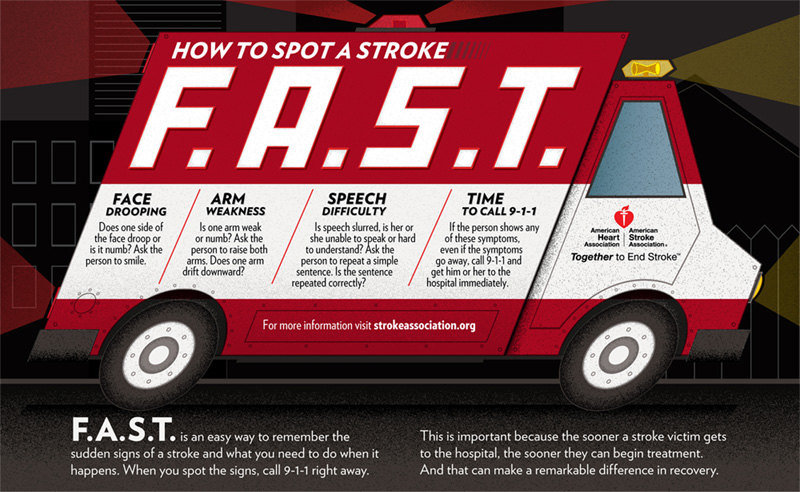
Think FAST
American Heart Association says despite benefit, hospitals alerted about incoming stroke patients only 2/3 of the time
July 14, 2012
Researchers say improved stroke care systems can address geographical and other factors affecting EMS pre-notification.
Dallas, TX – Treatment is delivered faster when emergency medical services (EMS) personnel notify hospitals a possible stroke patient is en route, yet pre-notification doesn’t occur nearly one-third of the time.
That’s according to two separate Get With The Guidelines®– Stroke program studies published in American Heart Association journals.
The American Heart Association/American Stroke Association recommends EMS notify hospitals of incoming stroke patients to allow stroke teams to prepare for prompt evaluation and treatment. [Read more]


