


American Heart Association reports Low Vitamin D at Birth raises risk of Higher Blood Pressure in Kids
July 14, 2019
 Dallas, TX – according to new research in the American Heart Association journal Hypertension, vitamin D deficiency from birth to early childhood was associated with an increased risk of elevated blood pressure in later childhood and adolescence.
Researchers followed 775 children from birth to age 18 at the Boston Medical Center. Most lived in a low-income, urban area and 68% of the children were African American. Low vitamin D levels were defined as less than 11 ng/ml (nanograms per millimeter) in cord blood at birth and less than 25 ng/ml in a child’s blood during early childhood.

The study findings suggest that vitamin D screening and supplementation in pregnancy and early childhood could prevent or reduce the risk of elevated blood pressure later in life. (American Heart Association)
American Heart Association says Heart risks in Middle Age Boost Dementia Risk later in Life
March 4, 2017
American Stroke Association Meeting Report
Houston, TX – People who have heart disease risks in middle age – such as diabetes, high blood pressure or smoking – are at higher risk for dementia later in life, according to research presented at the American Stroke Association’s International Stroke Conference 2017.
“The health of your vascular system in midlife is really important to the health of your brain when you are older,” said Rebecca F. Gottesman, M.D., Ph.D., lead researcher and associate professor of neurology and epidemiology at the Johns Hopkins University in Baltimore.
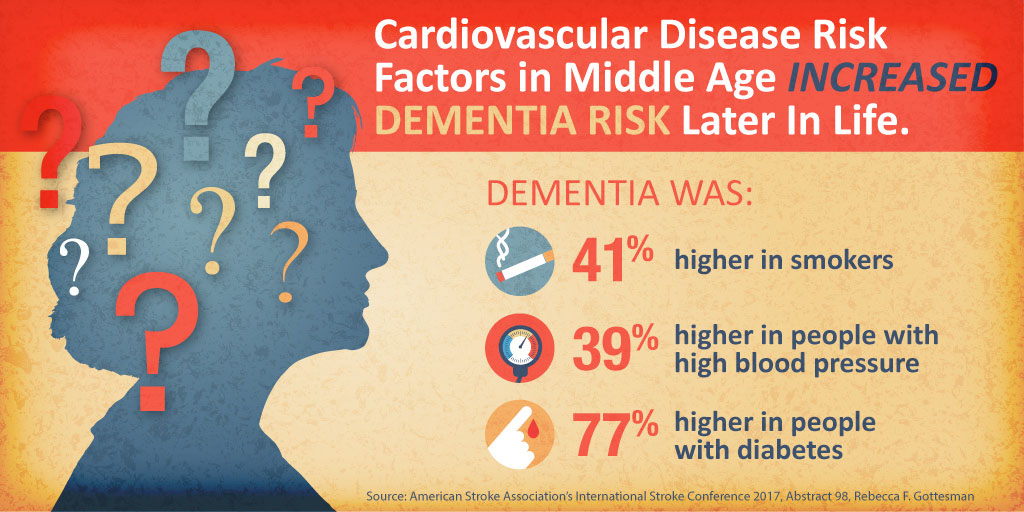
Cardiovascular disease risk factors in midle age increase dementia risk later in life. Dementia was: 41% higher in smokers; 39% higher in people with high blood pressure; 77% higher in people with diabetes. (American Heart Association)
American Heart Association says Semi-Veggie Diet effectively Lowers Heart Disease, Stroke Risk
March 16, 2015
Baltimore, MD – A pro-vegetarian diet – one that has a higher proportion of plant-based foods compared to animal-based foods is linked to lower risks of dying from heart disease and stroke, according to new research presented at the American Heart Association EPI/Lifestyle 2015 meeting.
In an observational study, researchers analyzed the eating and lifestyle habits of 451,256 Europeans. People who ate the most pro-vegetarian style diets (≥70 percent of food coming from plant sources) had a 20 percent lower risk of dying from cardiovascular disease, compared to those who were the least pro-vegetarian (<45 percent).

American Heart Association says Semi-Veggie Diet effectively Lowers Heart Disease, Stroke Risk
American Heart Association says early detectable Vascular Disease linked to Erectile Dysfunction
November 23, 2014
Chicago, IL – Men who have asymptomatic subclinical vascular disease are more likely to develop erectile dysfunction than men who don’t have early stage vascular disease, according to research presented at the American Heart Association’s Scientific Sessions 2014.
“Erectile function can be a window into men’s cardiovascular and overall health,” said David I. Feldman, B.S., lead author and research assistant at the Ciccarone Center for the Prevention of Heart Disease at Johns Hopkins in Baltimore, Maryland. “Erectile dysfunction and cardiovascular disease commonly coexist.” [Read more]
American Heart Association reports Heart Disease without coronary plaque buildup linked to Heart Attack Risk
June 11, 2014
Baltimore, MD – Non-obstructive coronary artery disease was associated with a 28 to 44 percent increased risk of a major adverse cardiac event such as a heart attack or death, in a new study presented at the American Heart Association’s Quality of Care and Outcomes Research 2014 Scientific Sessions.
Non-obstructive CAD damages the walls of the heart’s blood vessels, but doesn’t result in decreased blood flow or symptoms so it’s generally been considered to be a low-risk condition.
American Heart Association reports many Breast Cancer Patients don’t get treatment for Heart problems
June 10, 2014
Baltimore, MD – Only a third of older breast cancer patients saw a cardiologist within 90 days of developing heart problems, in a study presented at the American Heart Association’s Quality of Care and Outcomes Research 2014 Scientific Sessions.
Breast cancer patients with heart problems who saw a cardiologist were more likely to receive standard therapy for their heart failure than those who did not see a heart specialist, the study found. [Read more]
American Heart Association says more than 10 percent of Heart Attack Patients may have undiagnosed Diabetes
June 7, 2014
 Baltimore, MD – At least 10 percent of people who have a heart attack may have undiagnosed diabetes, according to new research presented at the American Heart Association’s Quality of Care and Outcomes Research Scientific Sessions 2014.
[youtube]https://www.youtube.com/watch?v=CbtNQ9fc0lM[/youtube] [Read more]
American Heart Association says Young Women fare worse than Young Men after Heart Attack
June 4, 2014
 Baltimore, MD – Women age 55 or younger may fare worse than their male counterparts after having a heart attack, according to new research presented at the American Heart Association’s Quality of Care and Outcomes Research Scientific Sessions 2014.
Researchers studied records and interviews of 3,501 people (67 percent women) who had heart attacks in the United States and Spain in 2008-12.
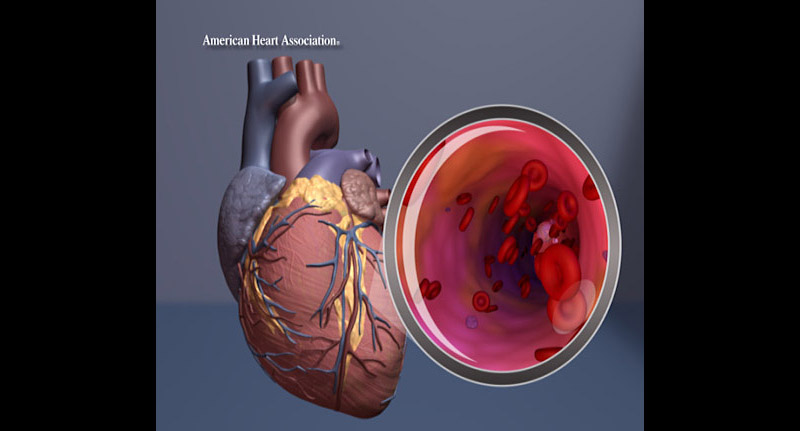
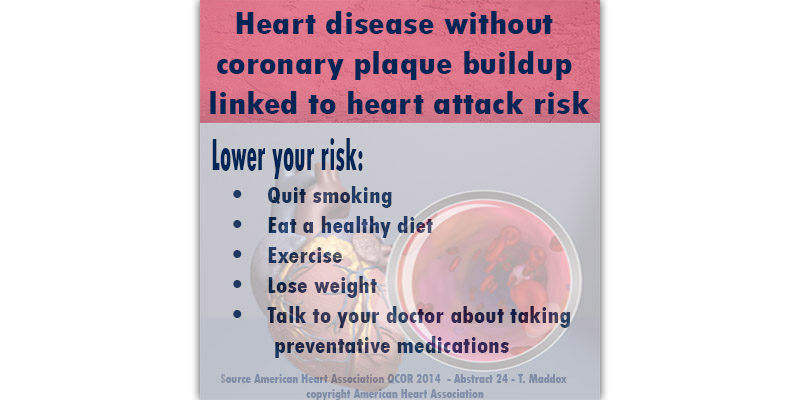
Heart illustration with artery close up. (American Heart Association)


